
Replacement Cost vs. Actual Cash Value: What It Means for Your Property Claim
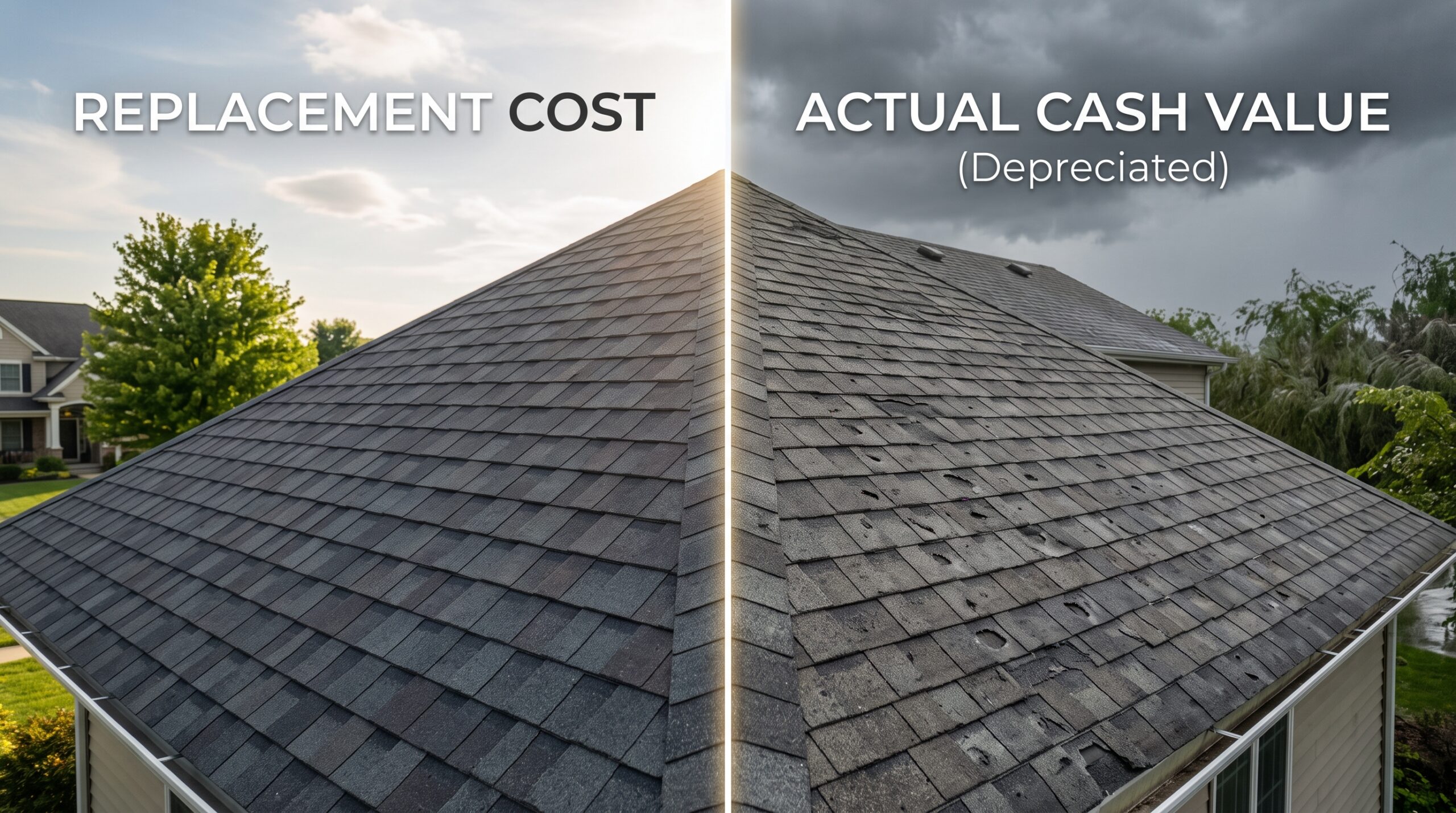
Two homeowners on the same street lose their roofs in the same hailstorm. Both have insurance. One gets a check big enough to put on a brand-new roof. The other gets a check for less than half that amount and has to cover the rest out of pocket.
The difference usually isn’t the insurance company, the adjuster, or the deductible. It’s two phrases buried in the policy: replacement cost and actual cash value. These terms decide how your insurer puts a dollar figure on what you lost, and they can change the size of a claim check by thousands of dollars.
Here’s what each one means, how they play out in a real claim, and how to decide which is right for your home, rental, or business property.
What Is Actual Cash Value (ACV)?
Actual cash value pays what your damaged property was worth at the moment it was lost, not what it costs to replace today. Most insurers calculate it like this: actual cash value equals replacement cost minus depreciation.
Depreciation is the value an item loses over time through age, wear and tear, and obsolescence. A 15-year-old roof, a 12-year-old furnace, or a couch you bought a decade ago has already used up much of its useful life, so an ACV policy only pays for the life that was left.
That sounds fair in theory. The catch is that you can’t buy a 15-year-old roof. When something is destroyed, you have to replace it with new materials at today’s prices, and an ACV settlement leaves you to cover the gap.
What Is Replacement Cost Value (RCV)?
Replacement cost coverage pays what it costs to repair or replace damaged property with new materials of like kind and quality, at today’s prices, with no deduction for depreciation. Your deductible still applies.
If a windstorm destroys your 15-year-old roof, a replacement cost policy pays for a new roof of similar quality. It doesn’t matter how old the old one was.
Many policies pay replacement cost claims in two steps. First, the insurer pays the actual cash value up front so you can start repairs. Then, once the work is done and you submit receipts or invoices, the insurer releases the withheld depreciation, often called recoverable depreciation or the holdback.
Policies often set a deadline for completing repairs and claiming that second payment. If you don’t repair or replace the property, you may only collect the ACV amount. Check your policy’s timeline before you file, and keep every receipt.
A Side-by-Side Example: The Hail-Damaged Roof
Let’s go back to those two neighbors. Say each roof is 15 years old with an expected life of 20 years, a new roof costs $20,000, and each policy has a $1,000 deductible.
The neighbor with an actual cash value policy starts with the $20,000 cost of a new roof. The insurer subtracts $15,000 in depreciation, because 15 of the roof’s 20 years (75 percent) were already used up. That leaves a $5,000 loss value. After the $1,000 deductible, the insurance company pays $4,000, and the homeowner pays the remaining $16,000.
The neighbor with a replacement cost policy also starts with the $20,000 cost of a new roof, but no depreciation is deducted from the final settlement. After the $1,000 deductible, the insurance company pays $19,000, and the homeowner pays just $1,000.
Same storm, same roof, same deductible, and a $15,000 difference in what comes out of the homeowner’s pocket. These figures are simplified for illustration. Real claims depend on your policy language, local labor and material costs, and how your insurer calculates depreciation.
Which One Is Right for You?
Replacement cost coverage costs more in premium because the insurer is promising to pay more at claim time. In return, your claim payout covers the full cost to replace your property minus the deductible, and your out-of-pocket risk after a loss stays low.
Actual cash value is cheaper up front, but your claim payout is reduced by depreciation, so your out-of-pocket risk is high, especially on older property.
Replacement cost usually makes sense if the property is your primary residence and losing it would upend your life, if you have a mortgage (some lenders expect replacement cost coverage on the dwelling), or if you couldn’t comfortably pay thousands of dollars to close the gap after a big loss.
Actual cash value may be reasonable if the building is older, rarely occupied, or worth less than it would cost to rebuild; if you’d likely sell or tear down rather than rebuild after a major loss; or if you’re intentionally trading lower premiums for more financial risk and have the savings to back it up.
Fine Print Worth Knowing
The replacement cost vs. ACV choice isn’t always all-or-nothing. A few related terms can matter just as much.
Dwelling vs. personal property: Your policy may value your home’s structure one way and your belongings another. It’s common to have replacement cost on the house but ACV on contents unless you add a replacement cost endorsement for personal property.
Roof payment schedules: Some policies settle roof claims on an ACV basis or use a schedule that pays less as the roof ages, even when the rest of the home has replacement cost coverage.
Extended or guaranteed replacement cost: Building costs can spike after a major storm or in a tight labor market. Extended replacement cost adds a cushion, often an extra 10 to 50 percent above your dwelling limit. Guaranteed replacement cost, where it’s offered, pays to rebuild regardless of your limit.
Coverage limits still matter: Replacement cost coverage only pays up to your policy limit. If your home is insured for $250,000 and rebuilding costs $350,000, you’ll be short. Review your dwelling limit regularly, especially after renovations or big jumps in construction costs.
Coinsurance requirements: Many commercial property policies, and some homeowners policies, require you to insure to a set percentage of the property’s value, often 80 percent or more. Fall below it and your claim payment can be reduced, even on a partial loss.
Ordinance or law coverage: Older buildings may need to be brought up to current building codes during repairs. Standard replacement cost coverage may not pay for those upgrades without this endorsement.
How to Check What You Have Today
You don’t want to find out which coverage you have while you’re standing in a damaged house. Pull out your policy and look for these four things.
Your declarations page: It typically lists your coverages, limits, and whether property is valued at replacement cost or actual cash value.
The loss settlement section: This part of the policy spells out exactly how claims are paid, including any separate rules for roofs or personal property.
Endorsements: Look for add-ons like replacement cost on contents, extended replacement cost, or ordinance or law coverage.
Your dwelling limit: Ask whether it still reflects what it would cost to rebuild your home today, not what you paid for it or its market value.
Talk With Royal Oath Insurance Group
The right answer depends on your property, your budget, and how much risk you’re comfortable carrying. Our agents can review your current policy, explain how your coverage would respond to a real claim, and compare the cost of upgrading to replacement cost protection.
Contact Royal Oath Insurance 586-238-3535 or info@royaloathinsurance.com today for a free coverage review, before the next storm decides for you.
This article is for general educational purposes and doesn’t change the terms of any insurance policy. Coverage varies by insurer, policy, and state. Refer to your policy documents or speak with a licensed agent for details about your coverage.